The Infrastructure Gambit: Why Africa's EV Giant is Betting Beyond the Bike
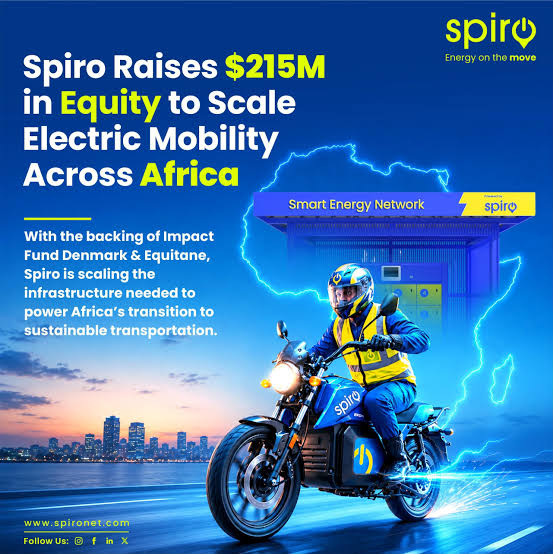
Spiro, an electric motorcycle startup, recently announced a colossal $215 million funding round, a figure that not only grabbed headlines but also cemented its position as one of the largest capital raises ever secured by an African mobility company. This significant injection, which contributes to over $500 million in total financing, including a $50 million facility from Afreximbank and a $100 million round in 2025, isn't just about scaling motorcycle sales; it marks a strategic pivot. The company’s plans for this capital offer a clearer insight into a future where vehicles are merely the entry point, not the destination.

The June 1 funding, led by Impact Fund Denmark and Equitane, brings Spiro’s total capital raised through debt and equity to more than $500 million. While current revenues are "primarily driven by vehicle sales," co-founder and chairman Gagan Gupta explicitly detailed a growth strategy focused on "expanding battery capacity, growing its swapping network and building energy services around it." Gupta clarified to TechCabal that "energy services, operations and maintenance contributing the remaining share" of revenue, acknowledging that significant demand for battery-swapping services will scale as motorcycle adoption increases.
### The Investor Mandate for Fundamentals
Across Africa's tech ecosystem, investors have become notably "more demanding about business fundamentals." Spiro's strategic shift directly addresses this, moving past pure growth metrics to prioritize "sustainable revenue, move towards profitability and maintain sound economics as they scale." The explicit focus on infrastructure, with its potential for recurring revenue, directly aligns with this stricter capital environment, signaling a maturity in how capital views long-term viability.
### Vehicles as a 'Hook,' Energy as the 'Cash Cow'
Spiro's model redefines the relationship between product and service. As Gupta articulated, "Vehicle sales serve as the entry point for market adoption." The critical insight is that "as fleet density increases, energy demand scales in a compounding manner and with it, the recurring, high-margin revenue profile that defines infrastructure businesses." This is not merely selling vehicles; it's building a utility and securing a continuous revenue stream from its operations.
### The Shift from Product to Platform
By emphasizing batteries, swap stations, and energy services, Spiro is transitioning from a traditional vehicle manufacturer's model to an integrated energy platform. This move signals an understanding that in emerging markets, the infrastructure enabling a new technology can be as, if not more, valuable and profitable than the technology itself, particularly when it generates predictable, compounding demand for essential services.

This pivot by Africa’s most-funded EV startup matters profoundly. It signals a maturation in how significant capital is being deployed within African mobility. Instead of chasing pure vehicle unit sales, Spiro is investing in the foundational assets that unlock sustained economic value from electrification. This strategy positions Spiro to benefit from the continuous energy consumption required by its fleet, effectively creating a captive market for its energy services. Spiro stands to gain a higher-margin, defensible business with recurrent revenue streams, while riders benefit from a robust and accessible battery swapping network, reducing range anxiety and charging downtime. Any competitor solely focused on selling electric vehicles without the integrated energy infrastructure that creates this ecosystem advantage may find themselves at a disadvantage. This model signals that for large-scale impact and profitability in African EV, the true play isn't just in the wheels, but in the electrons that power them.
The emphasis on energy infrastructure speaks volumes about the challenges and opportunities within African markets. Reliable and accessible energy is a perennial need. By building out battery capacity and a swapping network, Spiro is not just addressing mobility; it's embedding itself into the energy grid of the regions it operates in. This aligns with broader trends towards decentralized energy solutions and the critical role infrastructure plays in unlocking economic potential across the continent. It moves the conversation beyond mere adoption rates for new technologies to the essential framework that makes them viable and valuable in the long run.
Spiro’s colossal capital raises, culminating in the recent $215 million, underscore not just investor confidence in electric mobility, but a clear shift in strategic thinking. By prioritizing energy infrastructure over a sole focus on vehicle sales, Spiro is not merely selling motorcycles; it’s building a power utility. This calculated gambit for recurring, high-margin revenue through batteries and swap stations provides a blueprint for sustainable growth in Africa’s rapidly evolving, and increasingly scrutinised, tech investment landscape. It’s a testament to the idea that true market leadership often lies not just in pioneering a product, but in mastering the ecosystem that sustains it.